Science & Discovery
How did our Universe begin? How did life appear on Earth? How did human civilization develop, and what is our relationship with nature today? These are the questions we’ll explore here.
Earth is the one planet we all share, our spaceship traveling through space and time. Its fate is tied to ours.
Let’s find out how this remarkable planet works, how its systems are connected, and what we can do to keep our spaceship running for a very long time.
Platform: Windows PCs & Chromebooks (Optimized for mouse or trackpad; Chrome or Firefox recommended)
Сurriculum
-
The Origin of the Universe
Look into the history of the Universe through the evidence scientists can observe today. Explore the Big Bang theory, cosmic radiation, the formation of stars, and the life cycles of stars.
- Earth and Cosmology
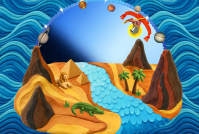
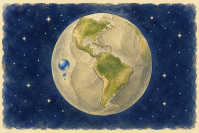
How has our picture of Earth and the Universe changed over time? Compare ancient Egyptian and Babylonian ideas with later scientific models, examine Earth from space, explore its internal structure, and investigate what makes our planet suitable for life.
- Evolution of Life on Earth
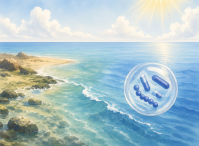
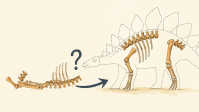
Travel through billions of years of Earth’s history, from the earliest life to complex organisms. Use fossils, geological layers, and scientific reconstructions to explore how life and the planet changed together.
- Mythical Creatures
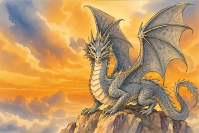
What happens when people try to describe animals they have never seen? Explore mythical creatures, medieval bestiaries, distorted eyewitness accounts, and the bits of real biology hidden inside old legends.
-
Cryptozoology: Monsters, Mysteries & Evidence
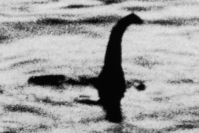
Yeti, the Loch Ness Monster, and other cryptids have fascinated people for generations. We will investigate the evidence behind these mysterious creatures and discover why some claims seem convincing, even when they don't stand up to scientific scrutiny.
-
Everyday Inventions: How Human Technology Developed
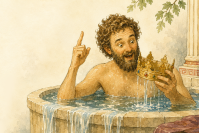
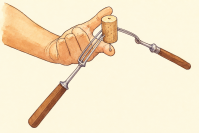
Soap, buttons, clothing, tools, and countless other ordinary objects had to be invented sometime. Trace the development of everyday technology and explore how human needs shaped new ideas.
-
Think Like a Scientist
Scientific discoveries often begin with an observation that does not quite fit. Investigate real cases from biology, chemistry, physics, and Earth science, make predictions, analyze evidence, and decide which explanations best match the facts.
-
-
Humans and Nature: From Survival to Environmental Impact
Follow the changing relationship between people and nature, from early human survival to modern agriculture, cities, industry, and resource use. Practice predicting the environmental consequences of human decisions.
-
IUCN Red List: Why Species Become Endangered
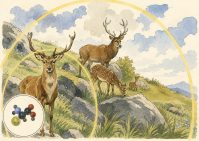
Why do some species become rare or disappear altogether? Explore the causes of extinction risk and learn how conservationists evaluate which species need protection most urgently.
-
You have enough resources to protect only a few wild places. Explore protected areas around the world, discover what makes each one valuable, and decide where conservation efforts are needed most.
-
Understanding Natural Phenomena
The natural world is full of clues. Practice observing patterns, forming explanations, and using evidence to work out why familiar natural phenomena happen.
-
Where Does Soil Come From?
Leaves fall, plants die, and organic material disappears into the ground. Explore decomposition, soil formation, and the organisms that recycle dead matter into new resources.
-
Ecosystem Health Detective
Plants, animals, fungi, and other organisms can reveal what is happening in their environment. Learn how bioindicators can provide clues about water, soil, weather, pollution, and other environmental conditions.
-
Home and Outdoor Safety
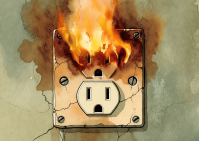
Everyday life comes with small risks and occasional big ones. Work through realistic situations and decide how to respond safely to hazards at home and outdoors.
-
Biological Laws and Patterns
Living systems follow recurring biological principles, whether organisms know about them or not. Explore patterns that shape survival, growth, reproduction, and interactions between organisms.
-
Levels of Organization
The living world can be explored at many scales, from molecules and cells to organisms, ecosystems, and the biosphere. Move through these levels and discover how smaller systems fit inside larger ones.
-
Parts of Flowering Plants
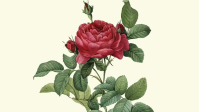
Explore flowers, fruits, leaves, stems, and inflorescences while learning how botanists identify and classify flowering plants. Along the way, discover why a cucumber is a type of fruit, a pear is botanically a pome, and juniper produces berry-like cones.
-
Rocks and Minerals Identification Lab
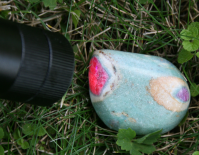
Learn to observe the features of rocks and minerals closely and use visible properties to identify them. Explore how different minerals form and where they can be found.
-
Physics is happening everywhere, even when nothing looks particularly dramatic. Use simple experiments to explore force, motion, balance, pressure, and other physical laws hidden in ordinary situations.
-
Chemistry in Everyday Life
People were using chemical reactions long before chemistry became a science. Explore how humans learned to make glass, metal, soap, fermented foods, and other materials, then investigate how chemistry gradually became a science based on prediction and evidence.
-
Water Cycle
Can an ocean really disappear down a leaking faucet? Follow water as it evaporates, condenses, falls as precipitation, moves across land, sinks underground, and returns again through the global water cycle.
-
How We Make Sense of Things
Thinking involves breaking problems apart, comparing information, finding patterns, and testing possible explanations. Practice these skills through puzzles and challenges drawn from biology, psychology, and everyday life.
-
Bionics: Engineering Inspired by Nature
Nature has been solving engineering problems for billions of years. Explore inventions inspired by plants and animals and see how engineers borrow biological ideas to create new materials, structures, and technologies.