






Microbiology-II
Greetings, determined microbe hunter.
These classes are much more challenging than the introductory course. Only the truly determined will make it all the way to the end. The microbes are counting on the rest to give up.
Your reward: a solid understanding of bacteria, microscopic fungi, algae, and protozoa.
Platform: Windows PCs & Chromebooks (Optimized for mouse or trackpad; Chrome or Firefox recommended)
Сurriculum
- Prokaryote Classification: Bacteria & Archaea
Biologists love organizing living things into groups. Prokaryotes make that surprisingly difficult. Explore how bacteria and archaea are classified, why their relationships can be hard to untangle, and what scientists use to tell them apart.
- Bacterial Shapes & Cell Structures
What can you actually find inside and around a bacterial cell? Explore common bacterial shapes and structures, from cell walls and membranes to flagella, pili, capsules, and internal components.
- Bacterial Growth & Reproduction
Bacteria are famous for dividing in two, but their life cycles are more varied than they first appear. Explore binary fission, budding, fragmentation, colony growth, and the different kinds of spores bacteria can produce.
- Bacterial Genetics: Genome, Plasmids & Gene Transfer
Bacterial cells may be tiny, but their genetics can be remarkably flexible. Explore bacterial chromosomes and plasmids, then discover how bacteria exchange DNA through transformation, transduction, and conjugation.
- Bacterial Metabolism: Photosynthesis, Respiration & Fermentation
How can bacteria live on light, chemicals, organic matter, or even gases? Break intimidating terms such as photolithoautotroph into manageable pieces and compare photosynthesis, respiration, fermentation, chemolithotrophy, and methanogenesis.
- Microbial Ecology: Habitats, Niches & Extremophiles
Microorganisms live almost everywhere, from soil and water to places that would kill most plants and animals. Explore microbial habitats, ecological niches, and the remarkable organisms that thrive under extreme conditions.
-
Heat, freezing, salt, pressure, radiation, toxins, antibiotics: microbes have answers for all of them. Investigate the strategies bacteria use to survive environmental stress and some of the most hostile places on Earth.
-
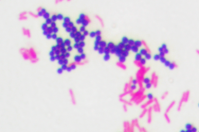
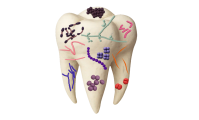
Your mouth is a crowded microbial ecosystem. Meet some of its normal inhabitants, learn how their populations change with conditions in the mouth, and use microscopic clues to investigate what is living there.
-
Gut Microbiome
Your digestive system feeds a huge microbial community along with you. Explore how gut microorganisms obtain food, interact with the human body, and contribute to digestion and other processes.
-
Photosynthetic Bacteria & Cyanobacteria
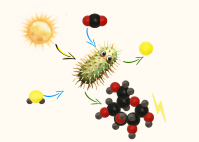
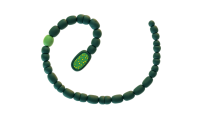
Some prokaryotes can capture light and turn it into chemical energy. Explore different types of bacterial photosynthesis, including the organisms that helped fill Earth’s atmosphere with oxygen.
-
Origin of Life
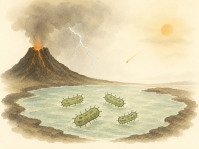
How did chemistry become biology? Travel through early Earth, prebiotic chemistry, the first organic molecules, competing origin-of-life hypotheses, and the evidence scientists use to reconstruct events billions of years ago.
-
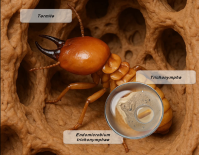
Endosymbiotic Theory: Origin of Mitochondria & Chloroplasts
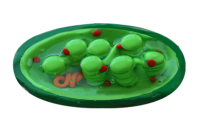
Some structures inside eukaryotic cells were once independent organisms. Examine the evidence that mitochondria and chloroplasts descended from free-living bacteria.
-
Microbial Symbiosis
Microorganisms rarely live alone. Explore ten partnerships between microbes and larger organisms and decide who benefits, who pays the price, and when a relationship changes from cooperation to conflict.
-
Lichens: A Microbial Partnership
A lichen may look like one organism, but it is actually a biological partnership. Explore how fungi, algae, cyanobacteria, and other microorganisms can form a remarkably successful living system.
-
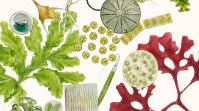
Algae Under a Microscope
“Algae” describes an extraordinarily diverse collection of photosynthetic organisms rather than one neat biological group. Examine microscopic algae, compare their structures, and discover just how different organisms hidden under this familiar name can be.
-
What Is Fungi? Types and Classification
A mushroom cap can tell you only so much. Explore the microscopic structures scientists use to study and identify fungi, from hyphae and spores to the reproductive structures that distinguish major fungal groups.
-
Protists Classification
Single-celled eukaryotes can be surprisingly elaborate. Explore different protozoan forms, compare their internal structures, and investigate how they move, feed, and reproduce.
-
Viruses: Structure, Replication & the Question of Life
Viruses exist on the border of what we usually call living. Explore their structure, see how they enter cells and reproduce, and examine why the question “Are viruses alive?” still makes such a good biological argument.
-
Biogeochemical Cycles: Nitrogen, Sulfur & Phosphorus
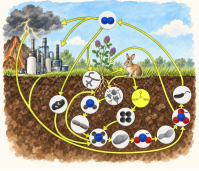
Matter moves through ecosystems again and again, and microorganisms perform many of the crucial steps. Build the nitrogen, sulfur, and phosphorus cycles by connecting organisms, compounds, and environmental processes into complete pathways.
-
Microscope Careers: Biology, Medicine, Forensics & More
A microscope can be a research tool, a diagnostic tool, a crime-solving tool, or even a way to examine rocks and gemstones. Explore careers that use microscopy and compare the very different kinds of work microscope skills can lead to.