-
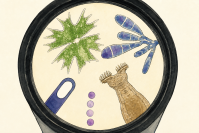
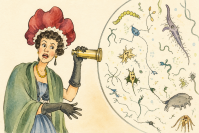
Who Lives in the Microworld
The world around us is full of organisms too small to see with the naked eye. Meet the major groups of microorganisms, discover where they live, and learn what actually belongs in the microworld.
-
How to Use a Microscope
Learn how to set up a microscope, place and focus a specimen, choose the right magnification, and take photos of what you see. You’ll also discover which objects can be observed with a light microscope and which ones cannot.
-
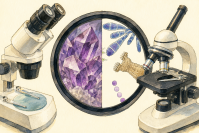
How Microscopes Work
Different microscopes reveal very different kinds of information. Compare microscopes designed to view surfaces, thin transparent specimens, cells, and structures far too small for ordinary light microscopy.
-
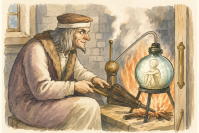
Spontaneous Generation: Can Life Appear from Nothing?
For centuries, people believed that living things could arise spontaneously from nonliving matter. Follow the experiments that challenged this idea and see how evidence gradually changed our understanding of where life comes from.
-
Who First Saw Microbes
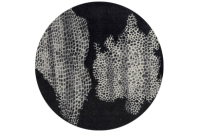
Who was the first person to observe microorganisms? The answer is more complicated than the usual story about Antoni van Leeuwenhoek. Explore the discoveries that came before him and why his observations still changed science.
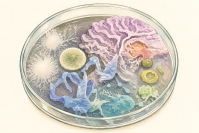
- Microbial Art
Microorganisms can create surprisingly beautiful patterns, colors, and light. Explore the artistic side of the microworld, from molds and colonies to glowing organisms and microscopic structures.
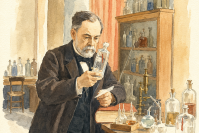
- Louis Pasteur: Microbiology Pioneer
Louis Pasteur worked during an extraordinary age of scientific discovery, but even by those standards, his list of achievements is impressive. Follow his experiments and see how one scientist helped transform microbiology, medicine, and our understanding of disease.
- Microscope Staining & Thin Section Preparation
Transparent specimens can be difficult to see under a microscope. Learn how staining increases contrast, prepare thin sections, stain bacteria with methylene blue, and practice using an oil-immersion objective.
-
The Cell Theory
Why are cells called the basic units of life? Explore what cells look like under a microscope, how they are organized, and why some living things consist of one cell while others depend on billions of specialized cells working together.
- Microbes That Clean the Planet
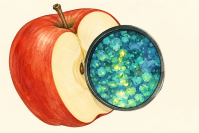
- Molds Under a Microscope
Leave bread, fruit, or another moist food long enough, and sooner or later something fuzzy may move in. Explore what mold really is, why it grows on food, how microscopic fungi differ from familiar mushrooms, and how common household molds can be recognized.
- The World in a Drop of Water
Can an entire world really fit inside one drop of water? Maybe not quite. But examine enough pond water, seawater, or aquarium water and you may discover an astonishing variety of microscopic life. Let’s see who turns up.
- Human Microbiome
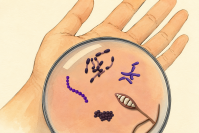
The human body is home to enormous microbial communities. Explore where microorganisms live on and inside us, why most are harmless or helpful, and how the human body becomes an entire habitat for microscopic life.
- Prokaryotic Cells
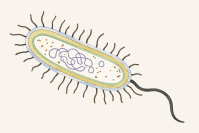
Bacteria may look like tiny dots and lines under a microscope, but their shapes and structures are surprisingly diverse. Explore Prokaryotic and Eukaryotic Cells, compare their structures, and discover how bacteria and archaea are organized. Interactive activities and Cell Diagrams for Labeling help students identify key cell structures and understand their functions.
- How Are Bacteria Different from Us?
Humans and bacteria seem completely different, but both are built from cells and share some of the same basic chemistry. Compare prokaryotic and eukaryotic cells and discover where the similarities end.
-
Bacterial Colony Shapes & Morphology
A single bacterium is invisible to the naked eye, but millions growing together can form a visible colony. Explore the shapes, edges, textures, colors, and other characteristics scientists use to describe bacterial colonies.
-
Helpful Microbes & Mutualism
Microorganisms are not always enemies. Explore microbes that cooperate with plants, animals, and humans, and discover how both partners can benefit from living together.
- How Were Viruses Discovered?
Viruses are far too small to see with an ordinary light microscope, which made them extremely difficult for early scientists to detect. Follow the clues that revealed the existence of infectious agents smaller than bacteria and changed microbiology forever.
-
How the Immune System Works
The immune system protects the body by recognizing and responding to potential threats. Explore how different defenses work together to detect pathogens, destroy infected cells, and remember previous infections.
-
Watch Out, Microbes!
Microorganisms are everywhere, but only some can cause disease. In this interactive challenge, investigate how infections spread and make practical decisions about hygiene, prevention, and everyday protection from harmful microbes.