




8th grade
Activities:
- Explore the idea of the Big Bang in simple terms
- Spot mistakes in a visualization of the Big Bang
- Search for evidence of the Big Bang in a popular science article
- Build a diagram showing how stars evolve
- Give creative names to nebulae based on their shapes
Bacteria Shapes & Structures
Activities:
- Identify basic bacterial shapes and arrangements
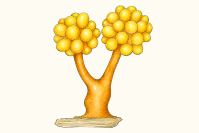
- Explore unusual species, including large or tree-like bacteria
- Compare what can be seen with light vs. electron microscopes
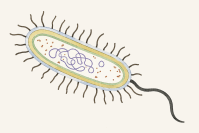
- Learn to recognize capsules, flagella, pili, and internal membranes
- Complete a short interactive review activity to reinforce their learning
Activities:
- Watch an engaging animation introducing bacterial and archaeal cell structures, with key differences from eukaryotic cells
- Match internal components to their functions and visuals, reinforcing understanding through visual memory
- Explore real-life questions: Is your cellphone dirtier than a toilet seat? Can bacteria jump onto food in seconds
- Reflect on the scientific implications of bacterial diversity and structure using humor and imagination
Activities:
- Discover microbial life on human skin, in clouds, deserts, and mountain air
- Investigate extremophiles thriving in hot geysers, deep-sea vents, and nuclear reactors
- Explore underground bacterial ecosystems that function without sunlight
- Reflect on the possibility of life beyond Earth
- Check their understanding with an end-of-lesson self-assessment
Levels of Organization
Activities:
- Name common biological molecules
- Identify cell structures shared by all living organisms
- Match tissue diagrams to real-life images
- Label organs within the digestive system
- Complete missing parts of organ systems
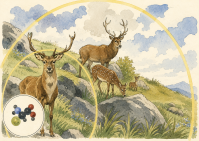
- Analyze populations by animal traces
- Explore communities, ecosystems, and the biosphere
- Reflect on the unique properties of each organizational level
histogram(S17_1LevelsOfOrganization
Pros and Cons of Zoos
Activities:
- Investigate why zoos exist and evaluate their role in wildlife conservation
- Analyze real visitor reviews to differentiate between objective problems and subjective opinions
- Reflect on natural habitats and wildlife reserves as alternatives to zoos
- Optionally, write an evidence-based, unbiased review after visiting a local zoo
Physics Detective
Activities:
-
Watch animations of 14 real-world experiments demonstrating physics in action
-
Read the name of each physical law or principle with helpful hints
-
Select which law best explains each phenomenon
-
Receive instant feedback to reinforce their understanding
Watch Out, Microbes!
Game
Caution, Microbes! is an interactive game where students use skill and observation to explore how infectious diseases spread, what symptoms they cause, and which defenses can stop them. Each microbe appears as a “wanted criminal” with its own profile, and learners investigate by choosing protections, identifying pathogens, and testing different treatment strategies.
The Science of Thinking: 17 Tools You Should Know
Activities:
Activities:
- Analysis: Identify structures shared by plastids and mitochondria.
- Synthesis: Assemble a flagellum model from its parts.
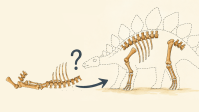
- Comparison: Compare two embryos and identify the human one.
- Abstraction: Identify a helicoid cyme by focusing on its essential features.
- Generalization: Find traits shared by all mammals.
- Sequencing: Arrange owls of different ages into the correct life cycle.
- Deduction: Use animal tracks and known facts to determine what happened.
- Induction: Examine several observations and infer a general conclusion.
- Analogy: Use a biological example as inspiration for an invention.
- Abduction: Infer the most likely diagnosis from observed symptoms.
- Association: Match cell organelles with familiar real-world systems.
- Imagery Manipulation: Transform a visual image to reveal biological differences.
- Exaggeration: Exaggerate body proportions to reveal the importance of different sensory and motor functions.
- Conceptual Blending: Combine unrelated traits and ideas to create something new.
- Pattern Recognition: Find camouflaged butterflies hidden in complex visual scenes.
- Numerical Reasoning: Analyze abstract numerical relationships that cannot be directly visualized.
- Trial and Error: Test different solutions until you find the correct arrangement.